

Does Rubber Thickness Really Matter — An Engineering Perspective
When an Australian sourcing engineer raised a question, we decided to share our answer from the engineering side
A Question Worth Answering Properly
Not long ago, a senior sourcing engineer from Australia asked us a deceptively simple question:
“If we want to optimize cost, can we reduce the height of one layer of the wiper rubber? And is wiper noise essentially caused by rubber being too thick?”
We welcomed this question.
Because it goes far beyond pricing.
It touches the core of wiper blade engineering:
How do we balance cost, structure, and real-world wiping performance?
This is not a question that deserves a simple “yes” or “no.”
So we decided to document our internal engineering logic, validation results, and design philosophy—and share them with B2B partners who care about long-term performance, not assumptions.
Part 1: Wiper Rubber Is Not “Just Rubber”
From the outside, a wiper rubber may look like a simple extruded strip.
From an engineering standpoint, a high-performance wiper rubber is a multi-layer system, where each layer serves a specific function.
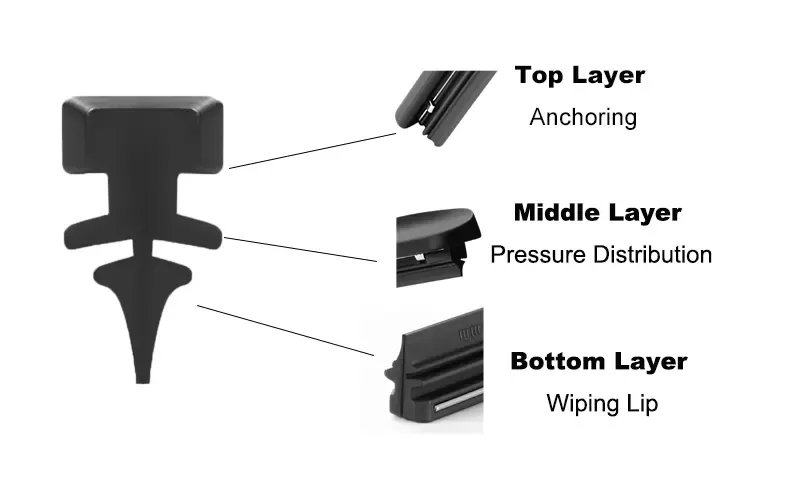
Take our widely used A-Series three-layer rubber structure as an example.
Top Layer: Structural Anchoring
The top layer ensures a secure mechanical connection between the rubber and the metal backing.
Prevents lift under high-speed airflow
Maintains stability under long-term vibration
It does not wipe water directly, but it determines whether the entire system remains stable.
All performance starts here.
Middle Layer: Pressure Distribution Control
(The real key to quiet wiping)
This is the most misunderstood layer.
The force applied by the wiper arm is concentrated.
The job of the middle layer is to transform that force into a smooth, evenly distributed pressure profile along the wiping direction.
Think of it as a pressure management system that:
Absorbs impact
Prevents localized overload
Suppresses chatter and instability
Reducing this layer’s functional space may appear to save cost, but it often disrupts pressure balance—causing localized skipping and impact against the glass.
That is one of the primary sources of noise and poor wiping performance.
Bottom Layer: The Wiping Interface
The lip edge is the most precise part of the rubber.
Geometry defines how the water film is removed
Compound formulation controls friction
However, its performance depends heavily on stable and uniform pressure delivered from the middle layer.
Improving lip material alone cannot compensate for poor pressure distribution.
Why System Balance Matters
Excellent wiper design is not about simplifying individual layers, but about ensuring that each layer fulfills its role within a balanced system.
Part 2: The Real Causes of Wiper Noise
Blaming noise on “rubber thickness” is an oversimplification.
Engineering requires identifying root causes.
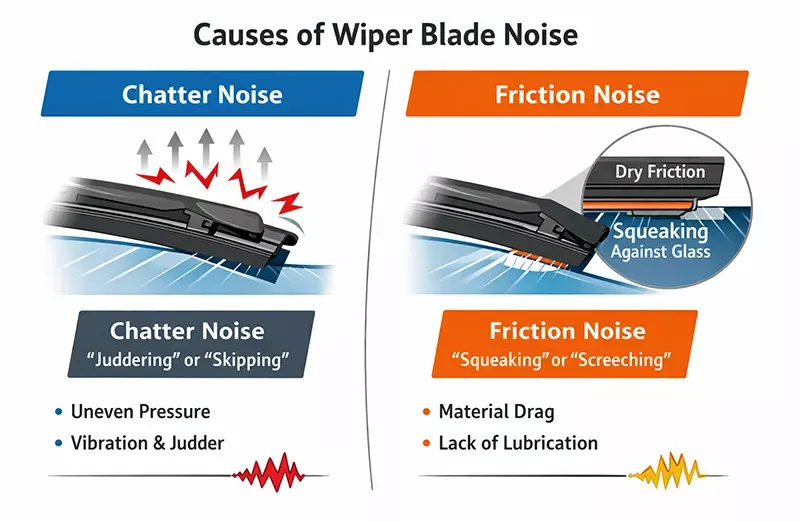
Based on extensive NVH (Noise, Vibration, and Harshness) testing, wiper noise generally falls into two categories:
Chatter Noise
Characterized by:
Clicking or buzzing sounds
Intermittent vibration
Main drivers include:
Uneven pressure distribution
Insufficient dynamic damping of the material at certain temperatures
Optimizing middle-layer structure and material behavior is far more effective than simply reducing thickness.
Friction Noise
Sharp squeaking sounds caused by interface friction.
This is typically addressed by:
Introducing self-lubricating materials such as graphite or PTFE into the lip compound
Reducing friction over the product’s service life
The Right Path to Noise Reduction
Noise reduction is not about “subtraction.”
It is about smarter optimization:
Pressure distribution curves
Material molecular structure
Lip-edge dynamic geometry
Part 3: When Change Is Required — Our Engineering Validation Approach
We fully understand the market’s demand for cost optimization without sacrificing performance.
The key is not whether to change—but how to change responsibly.
Rather than immediately modifying tooling, we follow a collaborative engineering validation process, supported by our vertically integrated rubber production line and full-system laboratory.
Our Engineering Workflow
1. Requirement Alignment
Define the real objective:
Cost structure optimization?
Noise under specific vehicle or climate conditions?
2. Platform Analysis & Prototyping
Simulations based on material and structural databases
Rapid prototyping on in-house production lines to ensure mass-production consistency
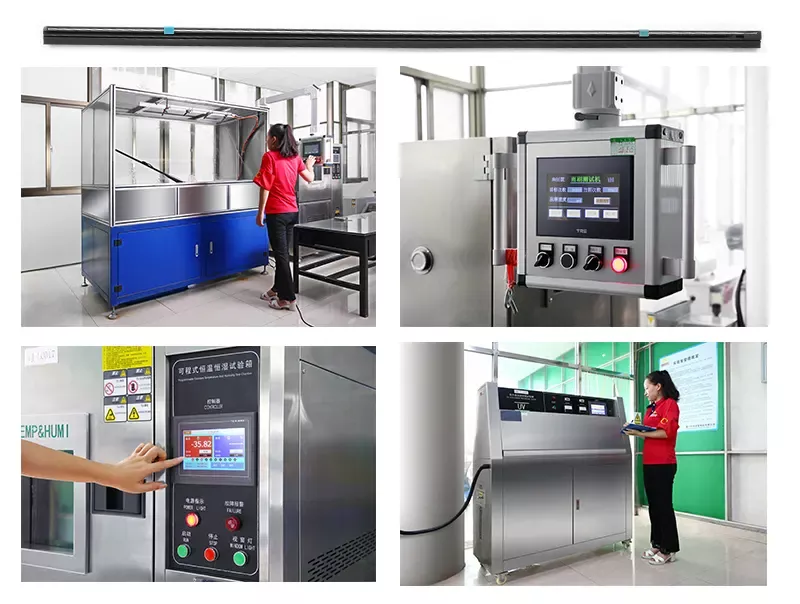
3. Laboratory Validation
Material aging: Ozone and UV exposure
Climate simulation: Extreme temperature and humidity cycles
Durability & NVH: Hundreds of thousands of wipe cycles with continuous noise monitoring
Dimensional accuracy: 2.5D optical measurement to ensure installation compatibility
4. Data-Driven Decision Making
Full test reports, performance comparisons, and cost analysis
Decisions based on lifecycle value, not assumptions
An Invitation to Become “Co-Engineers”
In today’s global automotive supply chain, strong partnerships go beyond transactions.
They are built on:
Respect for engineering logic
Trust in data
A shared commitment to solving complex problems
That Australian engineer’s question was a perfect starting point.
If you are facing wiper noise issues, structural challenges, or cost-performance trade-offs—Bring your questions.
Let’s start from each layer of the wiper rubber and work together, with engineering and data, to find the right balance.
Author: Amy Yang
Contact Email: enquiry@xmyujin.com
Release Time: Dec 17, 2025
Company: Yujin Xiamen Plastic Manufacturing Co., LTD.
Are you facing unstable quality, high return rates, or too many SKUs?
We supply wiper blades and related accessories for distributors and private label brands.
Send us your requirements. We will reply within 24 hours.