


Wiper Blade Adapter Types:OE Specific vs Multi Adapter Fitment
Oct 27, 2026One wiper blade fits several vehicles. Sounds like a buyer's dream, right?
Multi-adapter wiper blades can reduce SKU complexity and make inventory easier to manage. But there is a catch: one blade fitting several vehicles on paper does not mean it will fit every vehicle correctly in the real world.
For wiper blade distributors, wholesalers and aftermarket brands, choosing the right connection system is about more than convenience. It affects product coverage, installation time, inventory costs and, ultimately, return rates.
This guide explains the main wiper blade adapter types, compares OE-specific and multi-adapter solutions, and shows how to evaluate fitment coverage before placing your next order.
The short answer
OE-specific connectors offer a more vehicle-targeted fit, while multi-adapter blades can simplify inventory and broaden coverage. The best choice depends on your target vehicles, sales channel, fitment data and tolerance for installation errors.
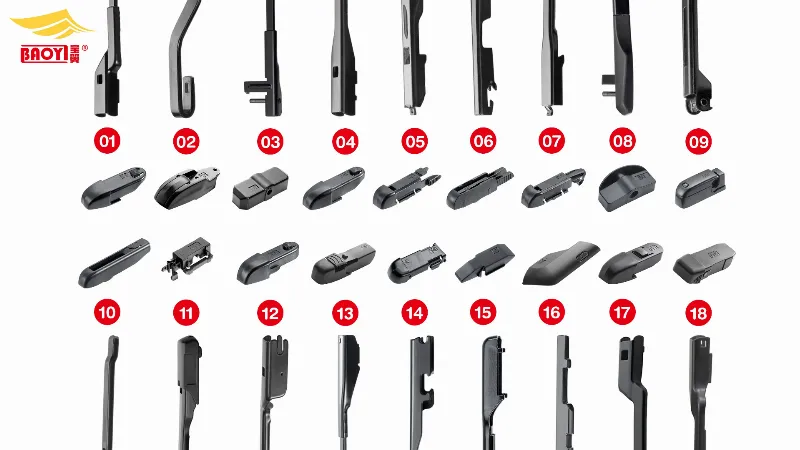
Common Wiper Blade Adapter Types
Wiper arms do not all use the same connection. Even when two blades have the same length, their adapters may not be interchangeable.
Here are five common connector families buyers should understand.
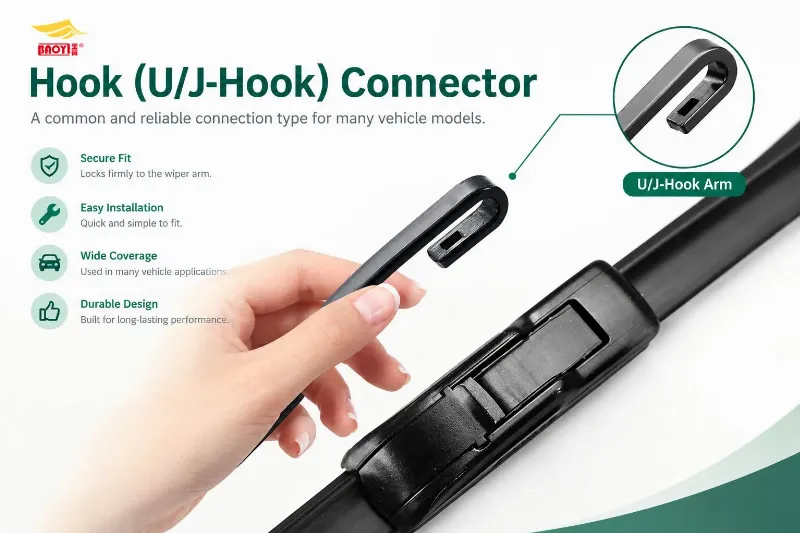
Hook-Type Connectors (U/J-Hook)
Hook-type arms are widely used across many passenger vehicles. The blade attaches to a curved hook, making this connection familiar to many installers and consumers.
Common in many aftermarket applications.
Generally straightforward to install when the blade and hook dimensions match.
Still requires the correct hook size and locking design.
Pin-Type Connectors
Pin-type systems use a pin on the wiper arm to secure the blade. Pin diameter, position and locking structure matter, so a connector that looks similar may not be a correct match.
Bayonet Connectors
Bayonet-style connections use a specific insertion and locking arrangement. They can be found on selected vehicle applications, and buyers should confirm the exact connector design before treating them as interchangeable.
Side-Lock Connectors
Side-lock systems secure the blade from the side of the arm. Different designs may look alike at first glance, but dimensions and locking mechanisms can vary.
Top-Lock Connectors
Top-lock connections secure the blade through a locking mechanism on the top of the adapter. They are used on selected vehicle applications and require the appropriate adapter profile.
Important for buyers: Connector families are a starting point, not a complete fitment guide. Always verify the vehicle application, model year, arm design and adapter dimensions. Regional differences and mid-cycle vehicle changes can affect compatibility.
OE-Specific vs. Multi-Adapter Wiper Blades
The key difference is how the blade connects to the vehicle and how many applications one product is designed to cover.
| Factor | OE-Specific Connector | Multi-Adapter Design |
|---|---|---|
| Fitment approach | Designed for a defined arm or vehicle application | Uses interchangeable or integrated adapters for multiple applications |
| Vehicle coverage | More targeted | Potentially broader, depending on the adapter range |
| Inventory | May require more application-specific SKUs | May consolidate some SKUs |
| Installation | Can be simple when correctly matched | May require selecting or changing the correct adapter |
| Main risk | More SKUs and possible slow-moving stock | Incorrect adapter selection or overstated fitment coverage |
| Best suited for | Defined applications and fitment-focused ranges | Selected high-volume applications and inventory simplification |
Neither approach is automatically better. A multi-adapter blade may reduce the number of products you stock, but only if its confirmed fitment coverage matches the vehicles your customers actually drive.
The Hidden Costs of “Universal Fit”
Universal fit sounds simple. Managing the exceptions is where things get complicated.
Imagine a distributor introduces a multi-adapter blade that is advertised for a broad range of vehicles. The catalog looks impressive, and the number of SKUs goes down.
Then the questions start:
Does the adapter fit every listed model year?
Can customers identify the correct adapter without opening the package?
Does the connector lock securely onto the arm?
Will installers understand the instructions?
Are front and rear wiper applications clearly separated?
If the answers are unclear, the apparent savings can be offset by extra customer-service work, incorrect installations, returns and negative reviews.
A lower SKU count is not the same as a lower total cost.
When comparing blade designs, include purchase cost, packaging, storage, installation support, returns and the cost of incorrect fitment—not just the unit price.
How to Evaluate Real Fitment Coverage
Do not judge a blade by the number of adapters in the box alone. Evaluate how many of your target vehicle applications those adapters actually cover.
Start with Your Target Market
Build a list of the vehicles your customers commonly service. Include model year, body style, front or rear position, blade length and connector type where applicable.
Then compare that list with the supplier's verified fitment data. A broad global application list may be less useful than a smaller, accurate list for your own market.
Use a Simple Coverage Calculation
You can estimate coverage with this basic formula:
Fitment Coverage (%) = Confirmed Compatible Applications ÷ Target Applications × 100
For example, if your target list contains 100 vehicle applications and the supplier can verify compatibility for 80 of them, the confirmed coverage is 80% of your target list.
This is an illustrative calculation, not a market benchmark. The quality of the vehicle list matters just as much as the percentage.
Watch Out for the 80/20 Trap
A blade may cover many applications but miss several important vehicles that account for a large share of your sales. On the other hand, a small number of low-demand applications may not justify stocking a separate SKU.
Review both application coverage and sales potential. This helps you decide which vehicles belong in your core range and which require a dedicated product.
Fitment Data: ACES, PIES and TecDoc
For aftermarket distributors and brands, the connector is only one part of the fitment puzzle. Accurate catalog data is equally important.
ACES: Used in the North American aftermarket to structure vehicle application data.
PIES: Used to organize product information, including product attributes and other catalog details.
TecDoc: An automotive aftermarket catalog and data ecosystem widely used in many international markets.
These systems serve different purposes, and their relevance depends on your target market and customer requirements. Confirm the required format with your buyers rather than assuming that one data format works everywhere.
When reviewing a supplier's fitment data, check whether it includes:
Make, model and model-year coverage.
Front or rear wiper position.
Blade length and connector information.
Known exclusions and vehicle variations.
Clear product identifiers and revision control.
A connector chart is useful. A connector chart linked to accurate vehicle applications is much more useful.
Choosing the Right Strategy for Your Sales Channel
For Traditional Distributors and Jobbers
Prioritize dependable fitment, clear product identification and manageable inventory. A combination of multi-adapter products for suitable applications and OE-specific products for exceptions may be more practical than relying on a single design.
For Retailers and Workshop Networks
Installation clarity matters. Easy-to-follow instructions, clearly labeled adapters and reliable application data can help staff select the right blade and reduce avoidable fitting errors.
For E-Commerce and Private-Label Brands
Online buyers cannot always compare the connector with the vehicle in front of them. Product pages should clearly state compatible applications, model years, blade position and any exclusions.
Good product information may not be the flashiest part of an online listing, but it can save everyone a surprisingly large amount of trouble.
Frequently Asked Questions
Are multi-adapter wiper blades universal?
No. They are designed to fit multiple applications covered by their adapter system, but they do not fit every vehicle. Always verify the exact vehicle and connector combination.
Do more adapters mean better fitment?
Not necessarily. The number of adapters alone does not prove coverage. What matters is whether the adapters match the arm designs used by your target vehicle applications.
Are OE-specific connectors better than multi-adapter designs?
Neither is universally better. OE-specific designs can be suitable for defined applications, while multi-adapter designs may help consolidate inventory where compatibility has been verified.
What should distributors request from a wiper blade supplier?
Request a connector chart, verified vehicle application data, installation instructions and details of any known fitment exclusions. For private-label projects, also confirm packaging options, product identifiers and the process for updating fitment information.
Can one blade cover both front and rear wiper applications?
Some product ranges may support selected front or rear applications, but this should never be assumed. Front and rear wipers can use different blade lengths, arm designs and connector systems. Verify each application separately.
Need a Wiper Blade Fitment Solution for Your Market?
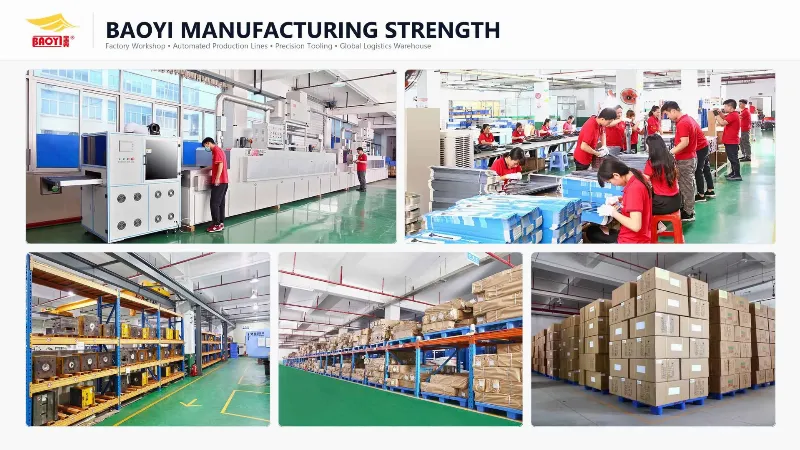
BAOYI supports wiper blade distributors and aftermarket brands with OEM/ODM services and product solutions for different vehicle applications.
Tell us your target market and product requirements. We can discuss suitable connector options and the fitment information needed for your range.
Request a Connector Chart & Fitment DataLooking for OEM/ODM wiper blade solutions? Let's build your brand together.