


Preparing Your Inventory for Heavy Rain Winter Seasons The B2B Guide to Stocking All Weather Wiper Blades
Oct 16, 2026Most importers place their winter wiper blade order in the same month the first snow arrives. By then the container has already missed the season. Factories that extrude wiper rubber and form spring steel are booked from late summer, ocean freight to Rotterdam or Los Angeles runs roughly 30 to 40 days before port dwell, and any new compound needs a sample round before a buyer should sign off on a full container.
The workable window is about two to three months, and it opens before your summer sell-through is finished. Below is a practical look at how an all-weather blade behaves below freezing and in storm rain, which blade types earn shelf space in which market, and how to set a size curve and adapter ratio that will not leave you discounting dead stock in April.

Why seasonal wiper blade stocking starts two to three months early
Wiper blades are not a product you can top up in a week. The spring steel inside a beam blade is formed on dedicated tooling, and the rubber compound has to be mixed, extruded and cured before it is cut to length. A private-label run with your own artwork adds proofing cycles on top of production: carton or blister film, barcode placement, and language panels for each destination.
Then comes the shipping leg. Thirty to forty days on the water is normal for Northern Europe and the US West Coast, and inland rail from a Chinese port to a Russian distribution hub adds more. Clearance, inland trucking and your distributor's own inbound processing eat another two weeks before a single blade reaches a shelf.
Buyers who place their wholesale wiper blade order early also get better terms. A factory can fold a confirmed order into an existing production line, while a late order becomes a rush job at a rush price, if it gets a slot at all.
What a late order actually costs
Placing a rush order once the season has already hit buys you expensive air freight on a product that wholesales for a few euros. Wiper blades are bulky relative to their value, so air freight rarely survives the math. The alternative is losing the season: blades move in a short window, and a distributor who cannot get stock at the first frost will not wait around mid-season.
Arriving early has a second benefit. The first container into a market sets the shelf, and installers reorder what they already know fits.
The sample round most buyers skip
Samples are not a formality. Ask for production-intent samples made from the actual compound and steel strip you are buying, not a stock item pulled from another line. Test them on the vehicles that matter in your market: a car that parks outdoors overnight in a freeze, and a car with a deeply curved windshield.
What "all-weather" actually means in wiper blade construction
Two components decide whether a blade works in January and still works in July.
The steel strip: curvature retention and contact pressure
The beam inside a flat blade is a pre-curved spring steel strip, sometimes two of them, held under tension against the rubber spine. Its job is to spread the wiper arm's pressure evenly along the blade. When that curve is inconsistent, or when the strip loses its memory after a season, pressure drops at the ends and the blade leaves unwiped arcs. Cold makes this visible: rubber stiffens as temperature falls, so it needs more force to conform to the glass, and a beam that felt fine at 20 °C will chatter at −10 °C. Curvature uniformity and contact pressure are worth testing on a sample rather than trusting a catalogue line.
The rubber compound: cold flexibility and heat set
Cheap compounds harden in the cold, and a hardened edge cannot flip cleanly on the return stroke. What you want is a compound that stays flexible well below freezing while resisting heat set when the blade sits on a windshield in direct summer sun. Suppliers commonly quote operating ranges around −40 °C to +70 °C. Treat that as a marketing range until the cold-flex and heat-aging reports are attached to it. Coatings on the wiping edge reduce friction so the blade glides instead of juddering, and ozone resistance matters for any blade that will sit in a warehouse for a season before it sells.
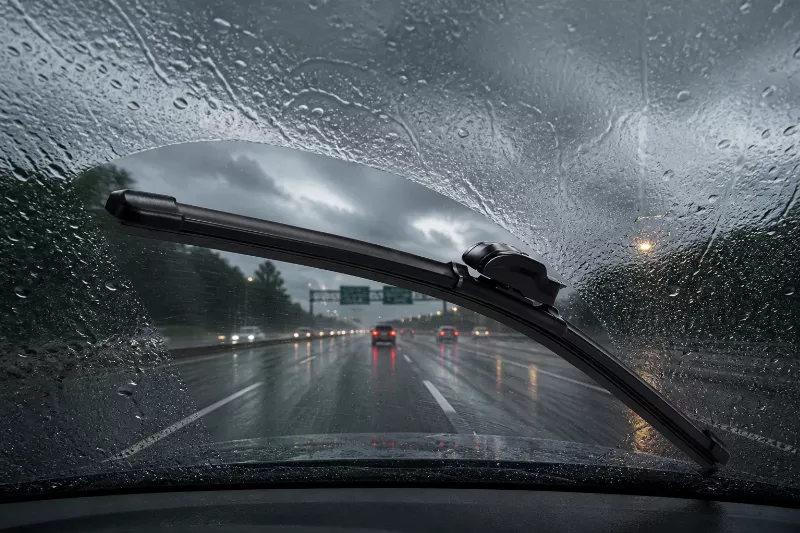
How winter cold and monsoon rain break wiper blades differently
Snow markets and monsoon markets generate different warranty complaints, and the countermeasures differ.
Snow and ice: load, stiffness and freeze-up
Conventional framed blades have exposed yokes and pivot points. Slush refreezes inside those joints, the frame stiffens, and the blade stops following the curve of the glass. A beam blade carries no exposed metal joints, so there is far less for ice to seize. Cold also reaches the connector: the plastic adapter that clips onto the arm needs low-temperature ductility, because a brittle adapter cracks when a driver prises a frozen blade off the glass by hand.
Monsoon rain: water volume and contact pressure
In heavy rain at motorway speed the blade is clearing a sheet of water, not a light mist. That takes steady pressure along the whole length. Wherever pressure drops, water stays behind and the driver sees the streaking that installers call smearing. Heat and UV belong in the same conversation, because the blade that spent a summer baking on a parked car is often the one that fails in the first storm. It is one reason wet-climate markets replace blades more often than their own order history suggests.
Beam blades and multi-adapter blades: what sells where
Both types are all-weather products. They solve different inventory problems, and the choice usually has more to do with your market's vehicle parc than with the blade itself.
| Beam (flat) blade | Multi-adapter blade | |
|---|---|---|
| Best fit | Modern parc, curved windshields | Mixed parc, older and newer vehicles together |
| Adapter | One connector format per region | Interchangeable adapters in one box |
| Freeze resistance | No exposed joints to ice up | Depends on adapter and joint quality |
| SKU pressure | More lengths, fewer connectors | Fewer SKUs cover more vehicles |
| Typical buyer | Distributors supplying garages | E-commerce, small importers, mixed containers |
Where each one earns its shelf space
A multi-adapter blade earns its place when your customers order in small quantities across many vehicle models, since one box can cover several arm types and you avoid carrying a long tail of slow-moving references. It also simplifies the counter: a shop that stocks one adapter set can fit more cars without opening a second box.
Beam blades earn their place with garages and chains that value speed. A modern vehicle with a curved windshield takes one length and one connector, the fitment is unambiguous, and the installer never has to choose an adapter. Where your mix runs heavily toward vehicles built after roughly 2005, the flat blade is the easier sale. Most importers carry both and split the range by vehicle generation rather than by price. You can see the formats we build on the BAOYI wiper blade range.
Building a size curve for your market's vehicle parc
Copying a competitor's range is the fastest way to carry the wrong lengths. Build the curve from registrations instead.
Start with parc data for each destination country: aggregate registration statistics for the EU, national registration authorities such as KBA in Germany or SMMT in the United Kingdom, and registration data providers for the United States. Rank the top 50 models by units, then map each model to its left and right blade length from a blade catalogue. Aggregate the lengths, weighted by registrations, and you have a defensible starting curve.
Two practical notes. Most vehicles use two different lengths, and on left-hand-drive cars the driver-side blade is usually the longer of the two, so plan in pairs rather than singles. Second, the aftermarket concentrates: catalogue lengths run from roughly 350 mm to 700 mm, or 14 to 28 inches, and a small group of mid-range lengths carries most of the volume in any European market. Which lengths those are shifts with the parc, so re-derive the curve each season instead of reusing last year's sheet.
How many SKUs is too many
Every extra reference costs shelf space at your distributor, minimum order quantity at the factory, and cash in your own warehouse. A common mistake is adding lengths to chase rare vehicles while the core lengths run out mid-season. Set the rule before you order: for example, no reference enters the range unless it maps to a model on your top-50 registration list, and every reference in the range has to be reordered at least once per season. Anything that fails both tests gets dropped.
Adapter ratio is the other half of the curve. Count which arm types appear among your top models — hook, pin, bayonet and the various locking formats — and stock adapters in proportion to the vehicles that need them, not in equal quantities out of habit.
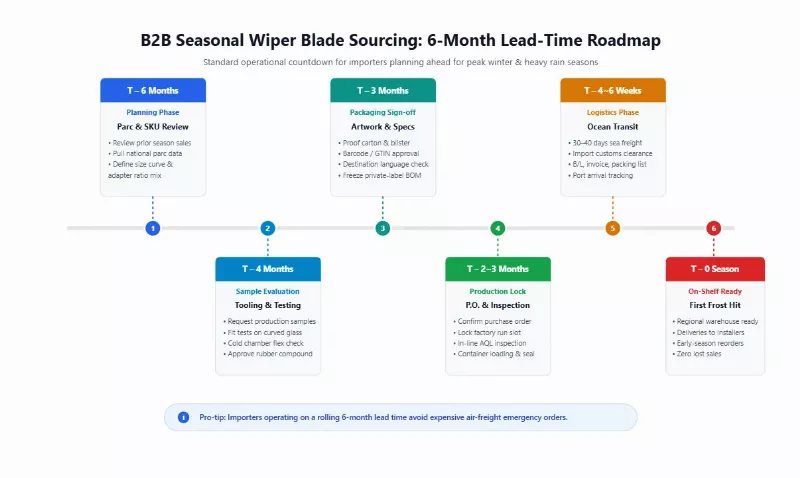
A six-month countdown to the winter season
Work backwards from the peak weather window in your target region — whether that is autumn monsoon storms, early sub-zero freezes, or mid-winter snow. Standard ocean lead times mean your operational timeline should look like this:
| Time before season | What has to be finished |
|---|---|
| 5–6 months | Sell-through review of last season; size curve and adapter ratio agreed |
| 4 months | Sample order placed, using the target compound and steel strip |
| 3 months | Samples tested on market vehicles; artwork and packaging approved |
| 2–3 months | Purchase order placed; production slot confirmed |
| 6–8 weeks | Production, in-line inspection, container loaded |
| 4–6 weeks | Ocean transit; customs documents prepared |
| 2–3 weeks | Goods landed; distributor launch to installers |
Two dates drive everything else: sample approval and purchase order placement. If either slips, the season is at risk, and expediting does not recover a month. The sell-through review deserves a proper meeting with your distributor's numbers rather than a glance at the last invoice, because it is where the size curve gets corrected.
Documents and quality checks to close before the container ships
Ask for these before you pay the deposit, not after a claim lands on your desk. A supplier who can send them quickly has usually run the tests in the first place.
Compound test reports: cold flex, heat aging, ozone resistance and edge abrasion
Curvature and contact pressure data for the steel strip, per length
Connector pull test and low-temperature impact test for the adapter plastic
Corrosion results for any exposed metal, which matters most in coastal and salted-road markets
AQL sampling plan and the in-line inspection record for the run
Packaging proof: carton or blister artwork, barcode and GTIN, destination language panels
Warranty terms in writing, including what a claim requires from the buyer
Two of these carry more weight than the rest on a seasonal order. Cold flex decides whether the blade survives its first winter, and the packaging proof decides whether it sells once it lands, because a carton carrying the wrong language panel will sit unsold no matter how good the rubber is. Settle both while the container is still being loaded, when a correction costs a phone call rather than a second shipment. If you want to see where those reports come from, our factory page covers the production and inspection setup.
FAQ
How far in advance should I place a winter wiper blade order?
Two to three months before the first cold snap in your market, and four months if either the compound or the packaging is new. The sample round is the step that most often pushes a project past its window.
Can one multi-adapter blade replace several part numbers?
It reduces the number, it does not remove it. Length still has to match the vehicle. What a multi-adapter design removes is connector duplication, which is where the SKU count usually balloons.
Which lengths should I stock first?
Whatever your own registration data puts at the top, not what a catalogue recommends. If you have no data yet, start with the lengths that fit the best-selling hatchback and mid-size sedan in your market, then let the first season's reorders correct the curve.
What temperature range should an all-weather blade handle?
Ask for the test reports rather than the marketing figure. Cold flex and heat aging data tell you how the compound behaves at the temperatures your market actually sees, and a quoted range with no report behind it is not a specification.
Do you supply samples for testing before a bulk order?
Yes. Testing on your own vehicles, in your own climate, is the only way to know whether a compound suits the market you sell into.
Need custom OEM wiper solutions or free samples for testing? Contact BAOYI team today.