


Common Wiper Blade Problems — A Practical Guide for Distributors & Aftermarket Buyers
Apr 29, 2026Most common wiper blade problems — such as streaking, noise, and skipping — are not caused by manufacturing defects.
They are usually related to normal wear over time or fitment issues in aftermarket applications.
In bulk distribution, the most effective way to reduce returns is to verify size, connector compatibility, and test samples before scaling orders.
What Distributors Keep Telling Us After Sales
Here’s something we hear very often from distributors:
“We didn’t have problems at the beginning. But after a few months, complaints started coming in.”
Not immediately after installation.
Usually later, after real use in the market.
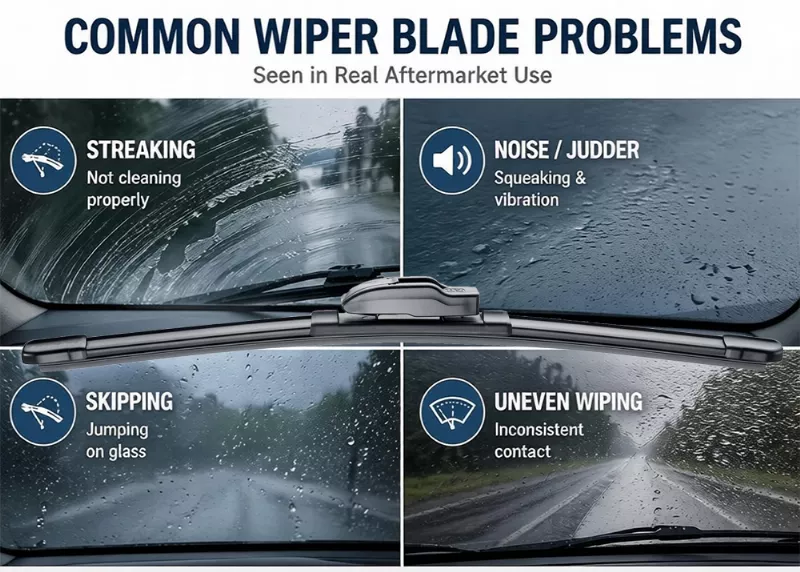
Streaking.
Noise.
Skipping.
Uneven wiping.
Sound familiar?
In the aftermarket wiper business, these are not rare cases.
They’re actually the most common feedback pattern we see across different regions.
Most of these issues don’t show up as “defective products” at first.
They show up as complaints, warranty claims, or replacement requests.
This is especially common for distributors sourcing aftermarket or wholesale wiper blades across different vehicle segments.
Before We Go Further — A Simple Way to Think About It
We usually look at wiper blade issues in a very simple way.
Most cases fall into two main categories:
Wear over time (usage-related)
Fitment or installation mismatch (compatibility-related)
Environment and usage pressure usually act as influencing conditions.
Not perfect science.
But in real bulk orders, this is usually enough to locate the problem quickly.
Streaking — The Most Frequent Complaint
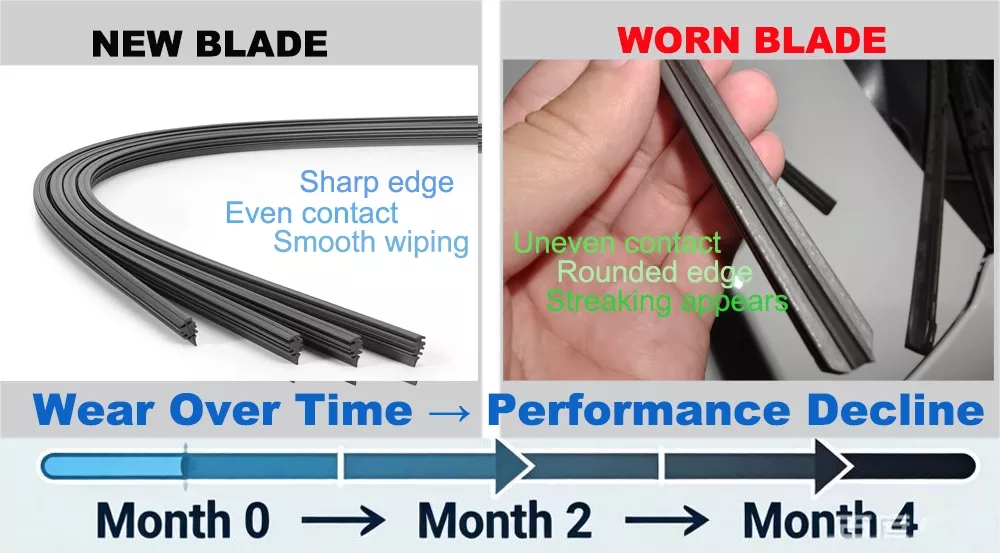
Most wiper streaking issues are caused by normal rubber wear over time, not product defects.
Customers often describe it as:
“not cleaning properly.”
“leaving lines on the glass.”
“works fine at first, then gets worse.”
In most cases, it doesn’t appear immediately.
It shows up after some time in real use.
From what we’ve seen, streaking is usually a gradual wear process.
In many markets, this aligns with typical wiper blade lifespan, where performance declines after a few months of use (often within a 6–12 month replacement cycle depending on conditions).
Many distributors initially treat this as a product quality issue.
But when we trace it back, it’s often linked to usage conditions and environment.
Noise or Juddering — Not Always a Product Issue
Noisy wiper blades are usually caused by friction, windshield condition, or arm pressure — not the blade itself.
Typical feedback:
squeaking sound
vibration on the windshield
unstable wiping movement
Noise usually comes from a combination of factors:
friction between rubber and glass (PTFE coated wiper blades)
windshield condition
wiper arm pressure
We’ve seen the same blade behave differently on two vehicles.
So instead of asking “Is the blade bad?”
It’s often more useful to ask:
What changed in the system?
Skipping or Uneven Wiping — Often a Fitment Issue
Wiper skipping is most often caused by fitment or compatibility issues in aftermarket applications.
Common causes:
incorrect size
connector mismatch (18 adapters wiper blade system)
uneven arm pressure
Especially when one SKU is used across multiple vehicle models.
What looks like a product issue often starts as a compatibility issue.
A Simple Field Check Before Replacing Products
We usually don’t start with replacement.
We start with a quick check:
Check size match
Check the connector locking
Check the installation condition
This simple check often solves many typical how to fix wiper problems cases in aftermarket service.
Quick Diagnosis Guide
If the issue appears early → check fitment
If it appears after months → check wear
If it varies by vehicle → check compatibility
These are general tendencies.
In real cases, factors often overlap.
One Thing We’ve Learned From Bulk Orders
Small mismatches early often turn into large return costs later.
Especially when working with new suppliers or wholesale product lines.
After improving fitment verification:
Complaint rates dropped noticeably
Not because the product changed —
But because the early mismatch was reduced.
What We Usually Suggest Before Scaling Orders
A small sample test across your main vehicle types
often reveals more than specifications alone.
Learn more about our manufacturing capability here: OEM windshield wiper blade manufacturer
If You Want to Reduce Wiper Returns in Your Market
If you're dealing with:
aftermarket complaints
inconsistent performance
multi-vehicle applications
We can help you cross-check:
size matching
connector compatibility
basic fitment
before bulk purchasing decisions.
FAQ — Common Wiper Blade Questions
How long do wiper blades last?
Typically 6–12 months, depending on climate and usage.
Why do wiper blades start streaking?
Usually, it is due to the rubber wearing over time.
How to fix wiper blade problems?
Check size, connector, and installation before replacing.
What causes noisy wiper blades?
Friction, glass condition, or arm pressure.
What causes wiper skipping?
Incorrect size or connector mismatch.