


Benefits of Multifunctional Rear Wiper Blades for Aftermarket Buyers
Jun 03, 2026Many aftermarket distributors focus heavily on front wiper blades when building their product range. Rear wipers are often treated as a secondary category.
That usually works at the beginning.
The challenge appears later.
As vehicle coverage expands, more rear wiper references are added to support different arm types, vehicle brands, and model generations. What started as a small category can gradually turn into dozens of individual SKUs sitting in the warehouse.
The issue is not simply storage space.
It is the growing amount of inventory management required to keep the category under control.
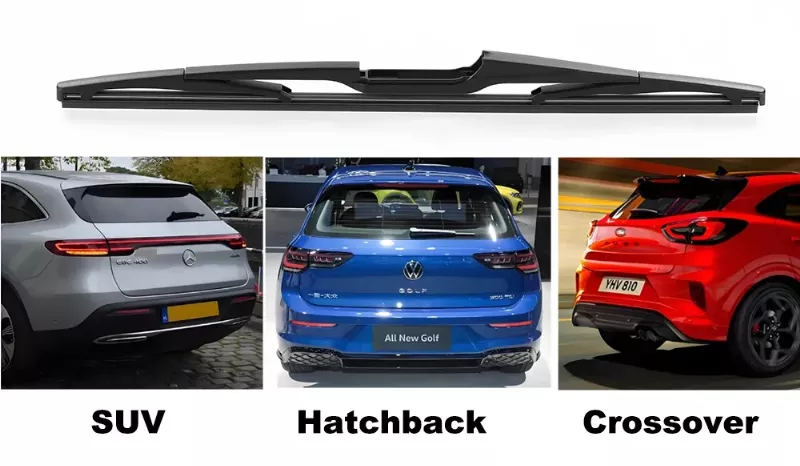
The Real Cost of Rear Wiper SKU Expansion
Most buyers compare rear wipers based on purchase cost.
Inventory complexity is often overlooked.
A distributor covering Japanese, Korean, and European vehicles may end up carrying 40 to 60 rear wiper references in order to achieve broad market coverage.
Every additional SKU creates additional work:
Inventory monitoring
Stock counting
Replenishment planning
Fitment verification
Warehouse organization
Some rear wiper references sell quickly.
Others may remain on shelves for months.
Yet both require management.
We've spoken with distributors who discovered that rear wipers represented a relatively small percentage of total sales but consumed a surprisingly large amount of purchasing and warehouse attention.
The problem is rarely visible at first.
It develops gradually as more exact-fit references are added to support wider vehicle coverage.
How Multi-Adapter Rear Wipers Change the Inventory Math
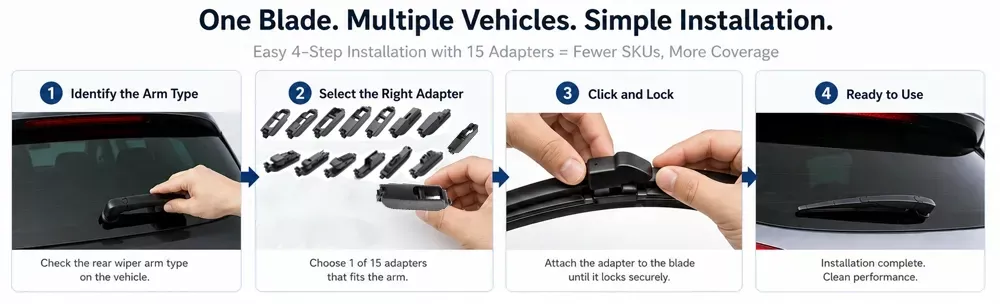
Multifunctional rear wiper systems were developed to address this issue.
The objective is not to replace every exact-fit rear wiper.
Instead, the goal is to cover a larger number of vehicle applications while reducing SKU complexity.
By using interchangeable adapters, a single rear wiper design can support multiple arm types and vehicle platforms.
A typical comparison may look like this:
| Inventory Metric | Traditional Exact-Fit Program | 15-Adapter Multifunctional Program |
|---|---|---|
| Active Rear Wiper SKUs | 40–60 | 8–15 |
| Vehicle Models Covered Per SKU | 1–3 | 12–18 |
| Typical Inventory Turns Per Year | 1.5–2.5 | 3.0–4.5 |
| Initial Stock Investment | 100% | 35–50% |
| Warehouse Complexity | High | Lower |
For distributors serving mixed vehicle populations, reducing SKU count can simplify forecasting, replenishment, and warehouse management.
In many cases, inventory efficiency becomes just as important as product coverage.
If you are evaluating broader rear wiper coverage, you can also explore our multifunctional rear wiper blade with 15 interchangeable adapters designed for aftermarket distribution programs.
Real Example: A Distributor in Australia
A distributor in Melbourne City originally stocked separate rear wiper references for Japanese, Korean, and European vehicle brands.
At first, the strategy made sense.
Different vehicles required different applications, and exact-fit products appeared to offer the safest solution.
Over time, however, the rear wiper category expanded to more than thirty active references.
Several products moved slowly. Some remained in stock for extended periods before being reordered.
The company later tested a multifunctional rear wiper system alongside its existing range.
Not every exact-fit reference was removed.
A number of vehicle-specific applications remained necessary.
However, after consolidation, the distributor reduced the number of active rear wiper references by more than half while maintaining coverage across the majority of its target vehicle applications.
According to feedback from the purchasing team, inventory reviews became easier, stock movement improved, and less time was spent dealing with compatibility questions.
Interestingly, the biggest benefit was not lower product cost.
It was reduced operational complexity.
Why This Approach Works in Mixed Vehicle Markets
Many aftermarket markets contain a mixture of Japanese, Korean, and European vehicles.
As coverage requirements increase, SKU counts tend to increase as well.
Multifunctional rear wiper systems help distributors support a wider range of applications without expanding inventory at the same pace. This is one reason they continue gaining popularity in Southeast Asia, Latin America, and parts of Eastern Europe where vehicle populations are highly diverse.
Packaging and Labeling Considerations

Inventory efficiency is not only affected by the product itself.
Packaging can also influence warehouse operations.
Some distributors prefer neutral packaging for wholesale distribution, while others require private label boxes, barcode labels, or retail-ready packaging.
Consistent packaging helps simplify inventory identification, stock handling, and order fulfillment. For distributors managing multiple sales channels, packaging flexibility often becomes part of the overall inventory strategy.
A Quick Check for Distributors
Before introducing additional rear wiper references, consider the following questions:
How many rear wiper SKUs currently contribute less than 20% of total category sales?
Are multiple references covering very similar vehicle applications?
How much time does your team spend answering rear wiper fitment questions each month?
The answers often reveal opportunities to simplify inventory structures without sacrificing market coverage.
Looking for a More Efficient Rear Wiper Program?
Multifunctional rear wiper systems are not designed to eliminate every exact-fit application.
They are designed to help distributors reduce SKU complexity while maintaining practical vehicle coverage.
Want to see how many SKUs you could cut?
Send us your current rear wiper SKU list and target markets. We'll send back a free, no-obligation inventory comparison showing potential consolidation using our 15-adapter system.
👉 Request Free Inventory Analysis