


Wiper Blade Differences
Sep 21, 2026Why Do Similar Wiper Blades Have Different Prices?
When buyers first receive our catalog, one of the most common questions is:
Why do some wiper blades look almost identical?
Why are there different prices?
Why are some models recommended for Europe while others are better for retail markets?
Why are there multiple beam blade structures?
Although many wiper blades share a similar appearance, the real differences are found inside the product.
Spring steel structure, rubber design, adapter systems, and customization options all influence performance, inventory planning and market positioning.
This guide explains the key differences between our wiper blade systems and helps you choose the right solution for your market.
What All Our Wiper Blades Have in Common
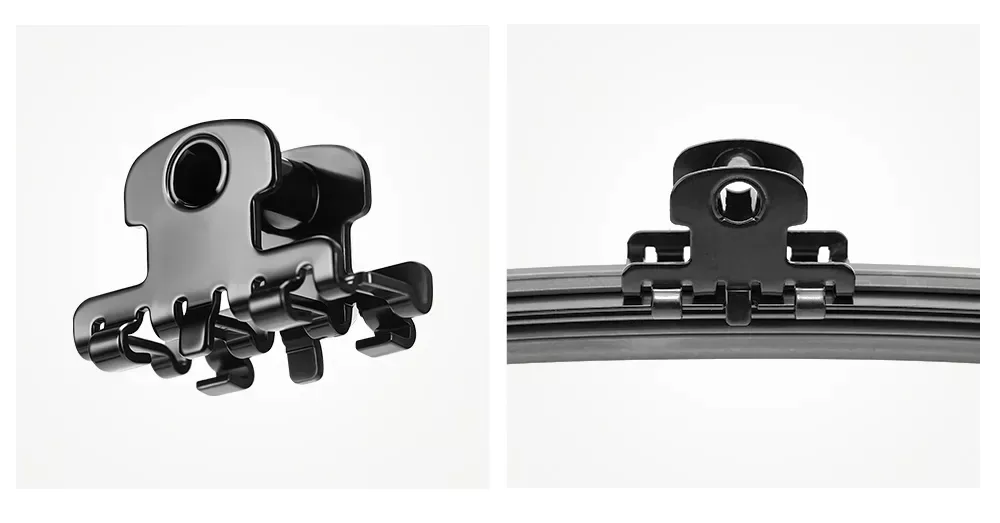
All our multifunction blades share the same alloy steel connector – it locks securely, resists corrosion, and fits multiple structures. And regardless of price level, every batch goes through the same quality checks: material inspection, wiping performance, salt spray, aging resistance, and final inspection. So you get consistent quality across the entire product range.
Learn more about our manufacturing process and quality control standards in our Wiper Blade Factory Overview.
What Makes One Wiper Blade Different From Another?
Although many models share the same connector and quality standards, they differ in four key areas:
Spring steel structure
Spoiler design
Rubber refill systems
Adapter configurations
All influence performance, inventory planning, and market positioning.
Difference 1: Spring Steel Structure
The spring steel system determines how pressure is distributed across the windshield.
Different vehicle types and market segments often require different pressure characteristics.
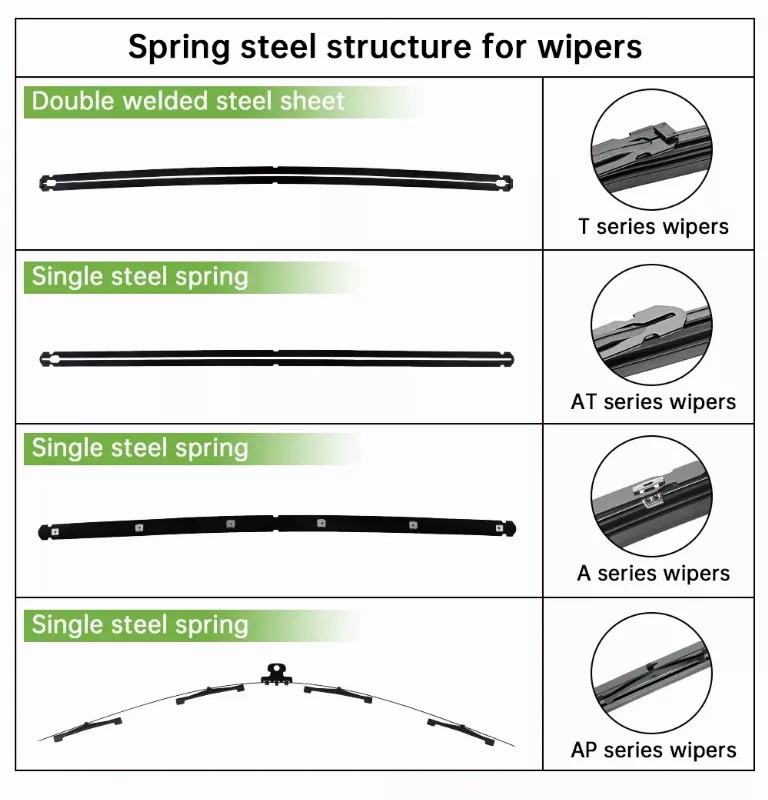
T Series – Welded Dual Spring Steel Structure
Two steel strips are welded at both ends. Pressure is slightly stronger at the ends, but flexible enough for daily driving. It’s a mature, cost-effective structure – predictable and widely used in general aftermarket sales.

Common models:
UT01、UT03、UT05、UT07、UT02、UT04、UT06、UT35、UT51、UT52、UT54、PT15、FT04、FT05、FT06、FT07、FT61、FT68、FT36、FT37、FT39、FT60、ET14、ET15、ET18、ET23、ET24、ET25、ET27、ET28、ET29、ET30、ET31、ET32、ET33、ET34、ET35
AT Series – Integrated Dual Spring Steel Structure
Continuous dual-steel design with no welding points. Pressure is distributed evenly across the blade, resulting in smoother and quieter wiping. A good step up for premium aftermarket lines without a major price jump.

Common models: FAT05、FAT06、FAT07、FAT37、FAT61
A Series – Single Spring Steel
Single steel strip with stainless steel retaining points to stabilize the rubber. Lightweight and responsive, ideal for smaller blades and rear wiper applications.

Common models: FA04、FA05、FA06、FA07、FA61、FA37
AP Series – Multi-Pressure Point Structure
Engineered with multiple pressure zones along the steel strip. Spreads force evenly across the wiping edge, improving contact on curved or large windshields. Built for premium retail programs and demanding weather conditions.
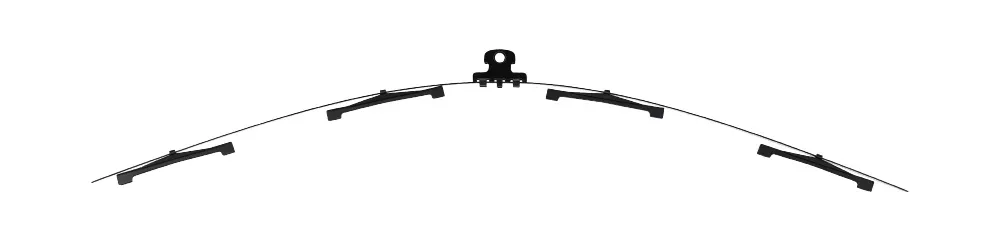
Common models: FAP66、FAP61、FAP06
Difference 2: Spoiler Design
Different wiper blade models may use different spoiler designs, but the purpose remains the same: improving aerodynamic stability at higher speeds.
We mainly offer two spoiler materials:
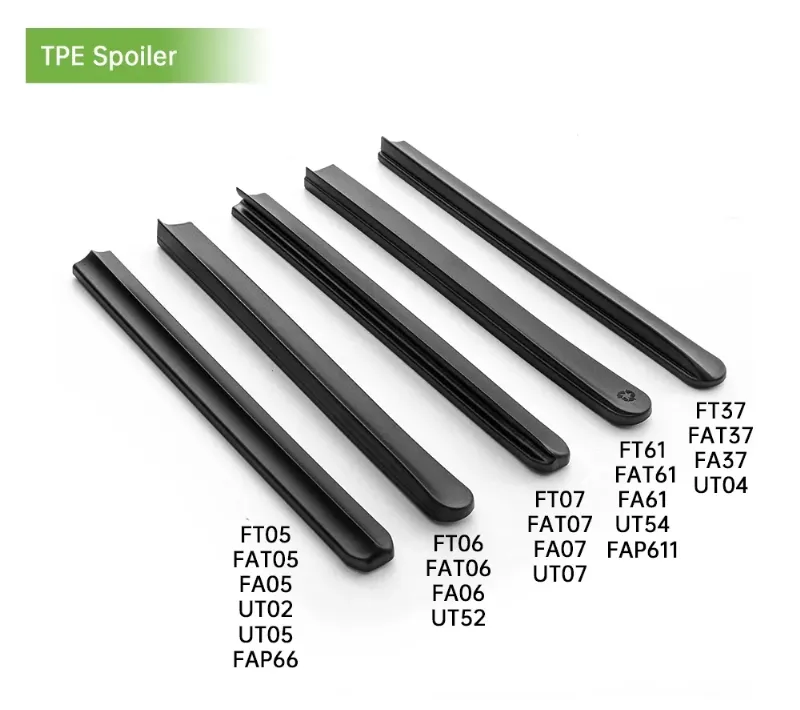
TPE One-Piece Spoiler
A modern integrated design without separate end caps.
Preferred by many retail customers because of its clean appearance.
TPV End-Cap Spoiler
A classic design with separate end caps.
Widely used in aftermarket replacement programs and familiar to most consumers.
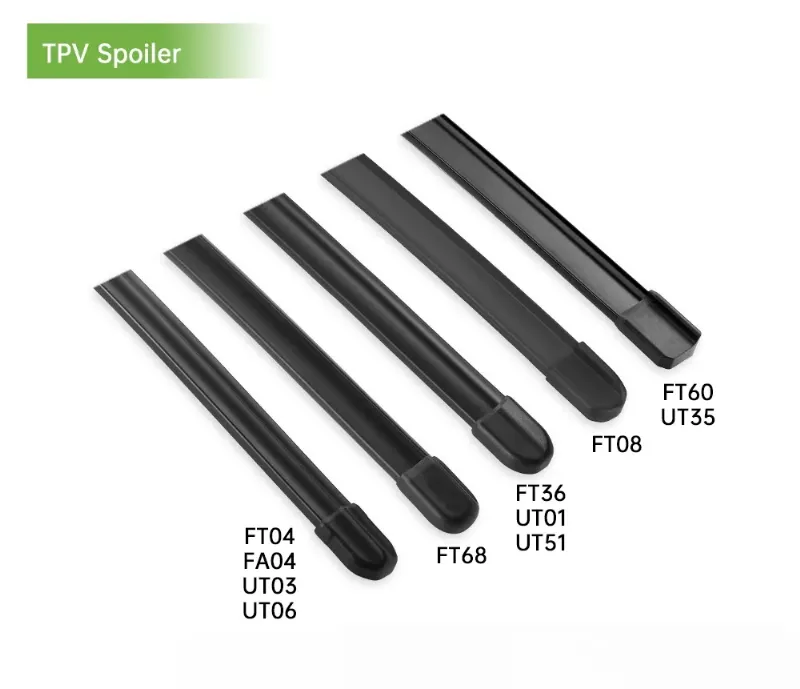
In terms of weather resistance, durability, and aerodynamic performance, both materials perform similarly. The difference is mainly visual.
Difference 3: Rubber Refill Systems
All refill options are made from high-quality natural rubber or silicone rubber with Teflon coating for smooth wiping and long service life.
Although the profiles and layer structures differ, all refill systems follow the same performance standards. They are designed to match different spring steel structures rather than create different quality levels.
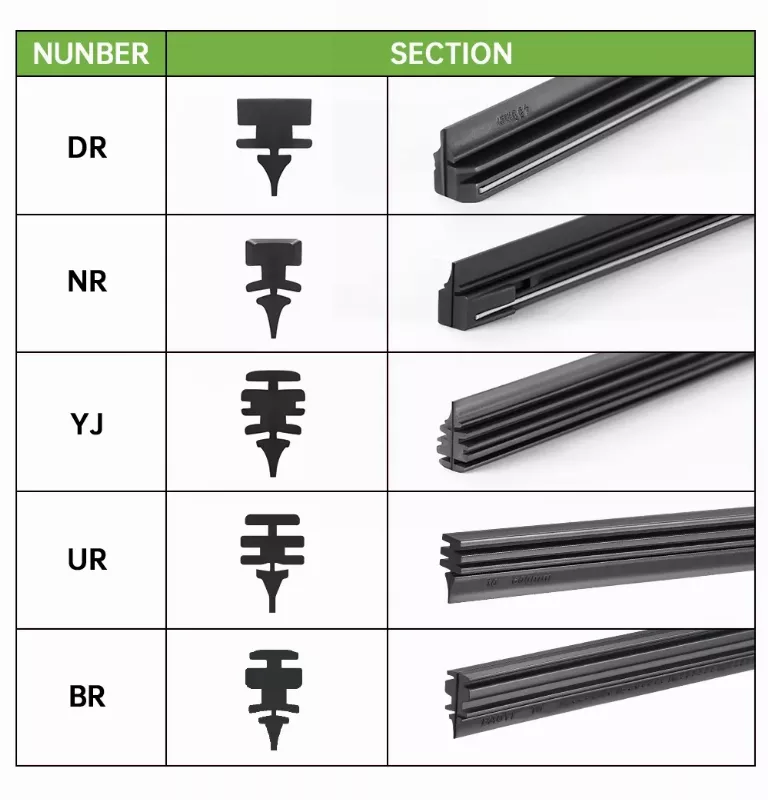
Quick Selection Guide
| Refill | Layers | Width | Compatible Steel | Key Feature |
|---|---|---|---|---|
| DR | 3 | 7mm | AP Series | Clean match, no excess layers |
| NR | 3 | 6mm | A Series | Narrow profile for lightweight system |
| UR | 4 | 7mm | T Series | Balanced, longer service life |
| YJ | 5 | 7mm | T Series | Softer, quieter operation |
| BR | 4 | 7mm | AT Series | Smooth pressure transfer |
Looking for replacement refills only? Explore our wiper blade rubber refill options for different steel structures.
DR Refill
Designed specifically for AP series structures.
Because AP steel already distributes pressure efficiently, a three-layer design provides sufficient flexibility without unnecessary complexity.
NR Refill
Developed for A-series single steel structures.
Its narrower 6mm profile reduces overall weight and helps maintain proper wiping pressure on compact systems.
UR Refill
Balanced four-layer structure.
Provides a good combination of durability and wiping comfort.
Often selected for markets where longer service life is prioritized.
YJ Refill
Five-layer structure optimized for smoother windshield conformity.
Often preferred when lower noise and improved wiping comfort are desired.
BR Refill
Designed for AT integrated steel structures.
Supports smooth pressure transfer while maintaining responsive wiping performance.
Choosing Between YJ and UR
Both are designed for the T Series.
YJ offers a softer wiping feel and slightly quieter operation.
UR provides a more balanced combination of durability and flexibility.
For most distributors, either option works well. The choice usually depends on local market preference.
Difference 4: Adapter Systems
Fixed Adapter System
Made for Japanese, Korean, and Chinese vehicles. Lower cost, simple installation, stable structure. Good for OEM replacement and vehicle-specific programs.
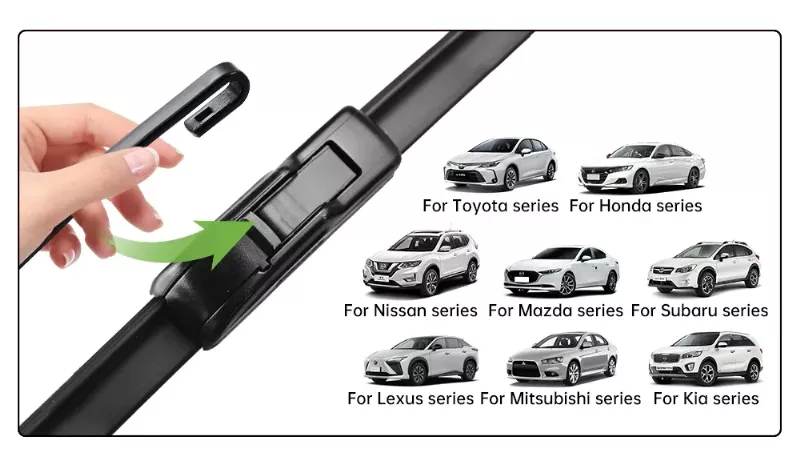
Multi-fit System
Includes 19 interchangeable adapters covering approximately 97% of passenger vehicles.
All our multifunction wiper blades use the same 19-adapter system, allowing distributors to cover multiple vehicle applications with fewer SKUs.
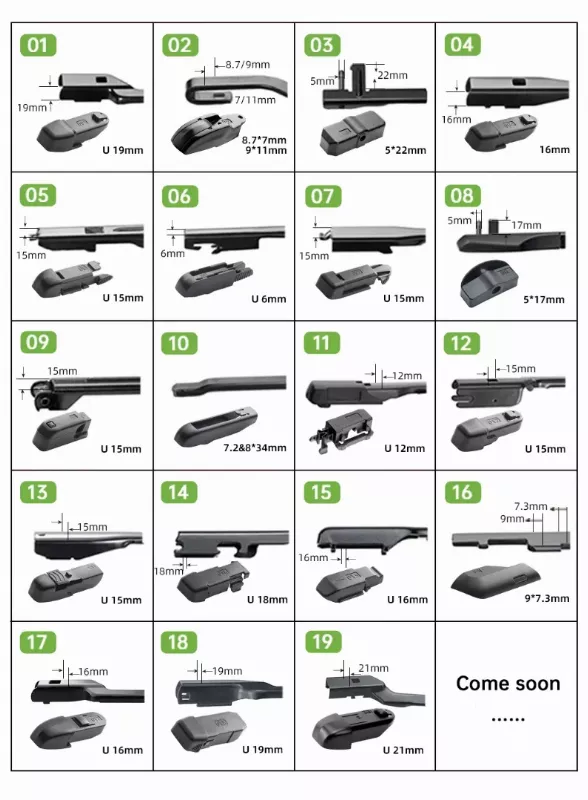
Which Wiper Blade Is Right for Your Market?
There is no single “best” wiper blade structure.
The right choice depends on your target customers, vehicle coverage, sales channel, and price positioning.
Quick Recommendation by Business Type
| Business Type | Recommended |
|---|---|
| Lowest cost | A Series + Fixed Adapter |
| General aftermarket sales | T Series + Multi-Fit Adapter |
| Premium retail products | AT Series + Multi-Fit Adapter |
| Reduced inventory | Multi-Fit Adapter System |
| Vehicle-specific programs | Fixed Adapter System |
| Private label branding | Any Series + OEM Packaging |

Still Not Sure Which Model to Choose?
Choosing the right wiper blade is not only about performance.
It also depends on:
Your target vehicle coverage
Sales channel
Price positioning
Inventory strategy
Branding goals
If you are unsure where to start, our team can recommend the most suitable product combination based on your market and business model.