

In aftermarket sourcing, confusion between wiper arms and wiper blades often leads to compatibility issues, installation problems, and increased return rates.
For Distributors & Importers
Incorrect matching between wiper arms and blades may result in:
Installation incompatibility
Customer complaints due to poor fit
Increased return and replacement costs
Understanding the difference between these two components helps you select more reliable product combinations for your market.
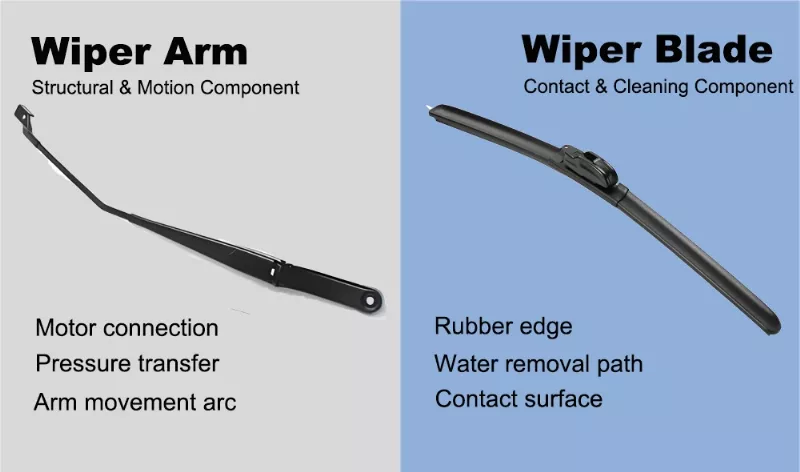
Wiper arms provide movement and pressure, while wiper blades perform the actual wiping function.
Although both components are part of the same wiping system, they serve completely different roles. Understanding how they function together is essential for product selection, compatibility, and long-term performance.
The wiper arm is the mechanical component that connects the blade to the motor and drives the sweeping motion across the windshield. It is typically made from metal or reinforced plastic to ensure durability under continuous use and exposure to environmental conditions.
For buyers, the design of the wiper arm determines connector compatibility, installation method, and pressure distribution across the blade.
The wiper blade is the part that directly contacts the windshield and clears water, dust, and debris. It is usually made from rubber or synthetic materials designed for flexibility, durability, and smooth wiping.
For distributors, blade quality directly affects noise level, wiping efficiency, and product lifespan—making it a key factor in customer satisfaction and repeat orders.
The wiper arm and blade function as a system. The arm provides the movement and pressure, while the blade performs the cleaning. Any mismatch between these components can lead to reduced performance or even installation failure.
Not sure which wiper blade fits different vehicles?
Blade size, connector type, and structure all impact compatibility and performance.
👉 Learn how to choose the correct wiper blade for different car models
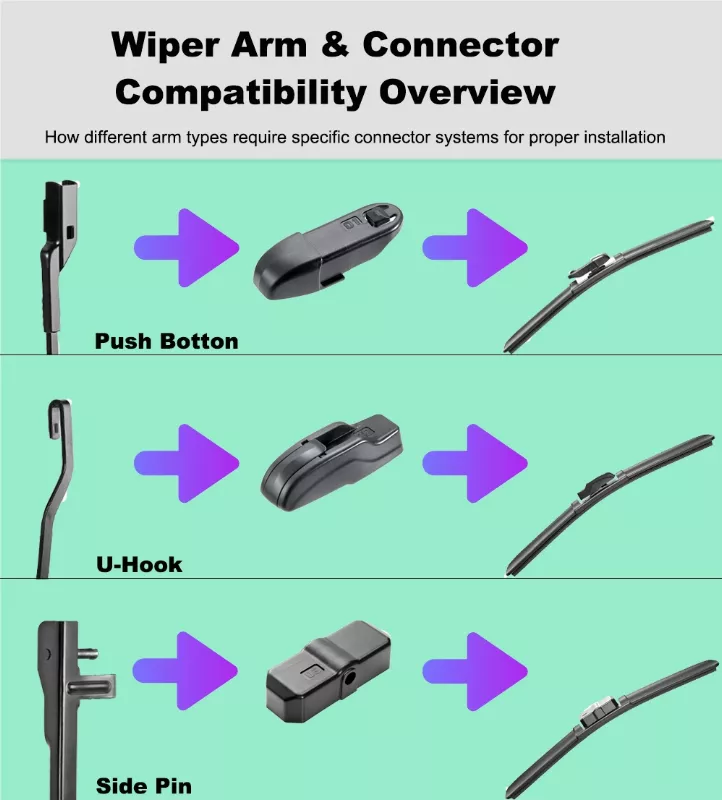
Connector types must match wiper arm designs to ensure proper installation and secure fit.
Many buyers treat wiper arms and blades as independent products. However, mismatched combinations often create hidden issues that affect overall system performance.
Incorrect connector types leading to installation problems
Uneven pressure causing streaking or incomplete wiping
Low compatibility across different vehicle models
Understanding the relationship between these components helps reduce after-sales issues and improve product consistency across markets.
Check connector compatibility with common vehicle types
Ensure blade material matches climate conditions
Evaluate pressure distribution from arm design
Work with suppliers offering stable quality and multi-fit solutions
A well-matched wiper system improves product reliability and reduces return rates, especially in bulk distribution.
We support distributors and importers with:
Multi-adapter wiper blade systems
Stable rubber quality and coating options
Wide vehicle compatibility coverage
OEM & private label support
📩 Contact us for catalog & wholesale pricing:
enquiry@xmyujin.com